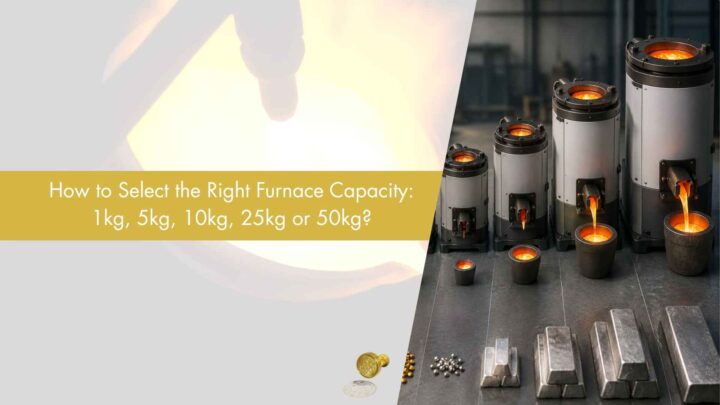
How to Select the Right Furnace Capacity: 1kg, 5kg, 10kg, 25kg or 50kg?
Selecting the right induction melting furnace is one of the most important decisions for any jewelry manufacturer, refinery, bullion producer, laboratory, or precious metal recycling business. Buying a furnace that is too small limits production, while choosing an oversized furnace increases your initial investment and operating costs. Whether you’re melting gold, silver, platinum, copper, brass, or other precious metals, selecting the appropriate furnace capacity ensures maximum productivity, energy efficiency, and return on investment. A tunnel furnace is a continuous heating system widely used in precious metals manufacturing, especially for producing gold and silver bars with consistent quality and high throughput. It allows controlled, uniform heating as metal moves through different temperature zones on a conveyor or track system. In this guide, we’ll explain how to choose between 1kg, 5kg, 10kg, 25kg, and 50kg induction furnaces, helping you make an informed investment. Why Furnace Capacity Matters The capacity of an induction furnace directly impacts: The right capacity should match not only your current production but also your expected business growth over the next 3–5 years. Discover the OPDEL iD Pro Series Induction Furnace, engineered for precision melting, energy efficiency, and superior performance. Factors to Consider Before Choosing Furnace Capacity 1. Daily Production Requirement The first question to ask is: How many kilograms of metal do you melt every day? Your answer will largely determine the furnace size you need. For example: Higher daily production generally requires larger furnace capacities. Experience seamless metal casting with the OPDEL Continuous Casting Furnace ‘Etna’ cD Series, built for consistency, reliability, and precision. 2. Type of Metal Different metals have different melting temperatures and densities. Common applications include: Some businesses process multiple metals using interchangeable crucibles. 3. Number of Melting Cycles Rather than focusing only on furnace size, calculate: For example: A 10kg furnace operating 20 cycles per day can produce approximately 200kg daily. OPDEL Static Furnace – Unmatched stability, precision, and performance for flawless melts. 4. Future Expansion Many businesses purchase a furnace only for current demand. However, production often doubles within a few years. Choosing a slightly larger furnace can avoid future replacement costs. 1kg Induction Furnace Best For Advantages Typical Applications If you’re producing custom jewelry or operating a boutique workshop, a 1kg furnace is often sufficient. 5kg Induction Furnace Best For Benefits Ideal Daily Production Approximately 30–80 kg/day, depending on cycle time. This capacity is among the most popular choices for expanding jewelry businesses. Pair your casting line with the 1kg Gold Induction Melting Furnace – 4 Station IGBT System to achieve faster melt cycles, precise temperature control, and consistent feed stock for flawless bullion bar production. 10kg Induction Furnace Best For Advantages Typical Applications A 10kg furnace provides an excellent balance between investment and production efficiency. 25kg Induction Furnace Best For Key Advantages Typical Daily Output Can exceed 300 kg/day, depending on operational hours. This capacity is commonly used where production consistency is critical. OPDEL Vulcano Series – Where relentless power meets flawless continuous casting. 50kg Induction Furnace Best For Benefits Applications A 50kg furnace is ideal for businesses handling substantial production volumes every day. OPDEL Etna CD Series – Precision and consistency inspired by Europe’s mightiest volcano. Furnace Capacity Comparison Furnace Capacity Best For Daily Production* Investment Level 1kg Small workshops Up to 15 kg Low 5kg Growing manufacturers 30–80 kg Moderate 10kg Commercial production 80–200 kg Medium 25kg Industrial production 200–400 kg High 50kg Large-scale manufacturing 400 kg+ Higher *Actual output depends on metal type, melting cycle, operator efficiency, and working hours. Common Mistakes When Selecting a Furnace Buying Only for Today’s Requirement Businesses often underestimate future production growth. Buying a slightly larger furnace can be more economical in the long run. Ignoring Power Availability Always ensure your facility has the required: Proper electrical planning prevents installation delays. Choosing Based Only on Price A lower-cost furnace may have: Evaluate the total cost of ownership, not just the purchase price. Overlooking Service and Support Reliable after-sales service is just as important as the equipment itself. Choose a manufacturer that offers: Continuous casting Furnace produces metal rods, strips, or profiles directly from molten metal in a continuous process, ensuring high productivity, uniform quality, and reduced material wastage. Which Furnace Capacity Is Right for You? Choose a 1kg furnace if you operate a jewelry workshop, laboratory, or require small-batch melting. Choose a 5kg furnace if your business is expanding and needs reliable daily production. Choose a 10kg furnace if you require consistent commercial manufacturing with higher output. Choose a 25kg furnace if your operation focuses on continuous production and industrial-scale efficiency. Choose a 50kg furnace if you run a large refinery, bullion production facility, or high-volume manufacturing plant. Why Choose OPDEL Induction Furnaces? OPDEL manufactures advanced induction melting systems engineered for precision, safety, and long-term performance. Features Whether you’re starting a jewelry business or expanding a precious metal refinery, OPDEL offers scalable furnace solutions tailored to your production requirements. Frequently Asked Questions (FAQs) Which furnace capacity is best for a jewelry workshop? A 1kg induction furnace is ideal for jewelry workshops, sample melting, and small-batch production. Is a 5kg furnace suitable for gold melting? Yes. A 5kg furnace is widely used by jewelry manufacturers and small bullion producers for efficient gold melting. Can one furnace melt different metals? Yes. Most induction furnaces can melt gold, silver, copper, brass, platinum, and other compatible non-ferrous metals by using the appropriate crucible and following recommended operating procedures. Should I buy a larger furnace for future expansion? If you expect production to increase within the next few years, choosing a slightly larger capacity can reduce future upgrade costs and improve long-term efficiency. Which furnace is suitable for a silver refinery? Silver refineries typically use 10kg, 25kg, or 50kg induction furnaces, depending on daily processing volume and production requirements. Final Thoughts Selecting the right furnace capacity is about more than the size of the crucible—it’s about matching your production goals, energy efficiency, and future growth plans. By evaluating your daily output, the type of metal you…